
Books Recommended by Our Teachers for Advanced Spanish Learners (B2–C2)
Updated: Mar 28
By Marycarmen Olivares and Gabriela Villa, Spanish Professors at Instituto Cultural Oaxaca.
For students who reach an advanced level of Spanish, reading literature often becomes a turning point in their learning process. Through books, students encounter new vocabulary, complex ideas, and cultural perspectives that go beyond everyday conversation.
At Instituto Cultural Oaxaca, reading is one of the ways students continue developing their Spanish while connecting with the cultures of Latin America. As Carlos Topete explains:
“By reading, you not only strengthen your reading and comprehension ability, but you also learn new vocabulary and develop other important skills such as writing and speaking.”
In addition to Marycarmen Olivares, Spanish teacher Gaby Villa also shares recommendations based on her experience working with advanced students, helping guide learners toward books that are both engaging and meaningful.
Literature That Connects with Students
According to Marycarmen Olivarez, students often connect deeply with books that explore contemporary themes such as identity, family relationships, memory, and personal transformation.
She has observed that many students, especially in literature discussions, are drawn to works written by contemporary Latin American women authors, whose voices offer both emotional depth and relevant social context.

One of the books that has resonated most with students is “El invencible verano de Liliana” by Cristina Rivera Garza, a powerful chronicle about the life of the author’s sister. The book has generated strong emotional responses and thoughtful reflections among readers.
Marycarmen also notes that contemporary works often help students expand their vocabulary by addressing topics that feel current and relatable.
This powerful and deeply personal story invites readers to explore memory, family, and justice while expanding their vocabulary through meaningful, contemporary Spanish.
Many of our students connect strongly with this book and find it sparks thoughtful conversations in our literature discussions.
Contemporary Spanish Books for Advanced Learners
Here are some Spanish books for advanced learners, recommended by our teachers for students at the B2–C2 levels.

La cabeza de mi padre — Alma Delia Murillo
This novel tells the story of a woman searching for the father she never knew, a journey that also transforms her family.
In literature discussions, this book has generated meaningful debate, especially around themes of parenthood and identity, where students often reflect on perspectives different from their own.
A great choice for those who want to practice Spanish while exploring complex and emotional themes.

El mar está lleno de medusas — Paola Carola
A story about personal growth and the transition into adulthood, this novel follows a woman as she navigates her twenties and prepares for motherhood.
Through the story of a woman navigating her twenties and preparing for motherhood, students can explore emotional and reflective language while expanding their Spanish vocabulary.
A great option for readers who enjoy introspective stories and meaningful conversation topics.
It offers accessible yet reflective language for advanced learners.
Fruto — Daniela Rea
Recommended by Marycarmen Olivarez, Fruto is a powerful work that explores motherhood, relationships, and the emotional complexities of raising a child.
Through its intimate and reflective tone, the book invites readers to think deeply about family, care, and personal identity, while exposing them to nuanced and expressive Spanish.
Temporada de huracanes — Fernanda Melchor
A widely acclaimed novel known for its intense narrative and complex language, this book explores themes of violence, superstition, and social reality in rural Mexico.
Recently adapted into a Netflix series, it offers advanced learners a challenging and rewarding reading experience.
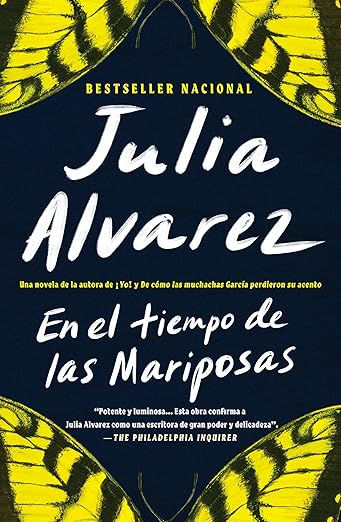
En el tiempo de las mariposas — Julia Álvarez
This novel tells the story of the Mirabal sisters and their resistance to political oppression in the Dominican Republic.
This powerful story brings history and personal courage together through the lives of the Mirabal sisters. Many students find it especially engaging because it has also been adapted into a film, helping connect the reading with a visual experience.
Spanish teacher Gaby Villa recommends this book because students often find it more engaging when a story is also
available as a film or television adaptation. Connecting the book with a visual version can help deepen understanding and maintain motivation.
A great choice to practice Spanish while exploring history, identity, and resilience.

Huracán — Sofía Segovia
Another recommendation from Gaby Villa, Huracán takes place in a small fishing town as a storm approaches.
The novel explores both the physical impact of the hurricane and the emotional struggles of its characters, including the working conditions of hotel staff who must remain on duty during the storm rather than be with their families.
It also portrays the personal “storms” within relationships, offering a compelling and layered narrative for advanced readers.
Mal de amores — Ángeles Mastretta
Recommended by Gaby Villa, this novel is set during the Mexican Revolution and follows Emilia Sauri as she navigates love, independence, and social expectations.
The story offers a vivid portrayal of Mexican history while exploring themes of identity and personal freedom. It has also been announced for adaptation into a Netflix series, making it especially engaging for students who enjoy connecting literature with visual storytelling.
Classic Recommendations
While contemporary literature is often more accessible to students, our teachers also encourage students to explore classic works.
Cien años de soledad — Gabriel García Márquez
Pedro Páramo — Juan Rulfo
Many students have read Cien años de soledad in English, but reading it in Spanish allows them to experience the richness of the original language.
Practicing Spanish Through Literature
Reading literature allows advanced students to engage with Spanish in a deeper and more meaningful way.
Students not only learn new vocabulary but also encounter different ways of expressing ideas, emotions, and cultural realities.
A single chapter can lead to discussions about family, history, identity, and society, helping students expand both their language skills and their understanding of the Spanish-speaking world.
The Instituto Cultural Oaxaca Literature Club
For students who want to explore Spanish literature in a guided and interactive environment, Instituto Cultural Oaxaca offers an online Club de Literatura.
The club meets once a week in one-hour sessions, and each course usually runs for 8 to 10 meetings.
Students read a portion of the book before each session and then join a live discussion where they share their opinions and interpretations.
Sessions are moderated by Marycarmen Olivares, and sometimes by Paty Castellanos, both experienced teachers at Instituto Cultural Oaxaca.
The club is designed for students at B2 level and above who want to continue developing their Spanish through literature and conversation.


Comments